
We have all been there. You walk into the gym, scan the rows of identical gray machines, and sigh. You plug in your headphones, stare at a wall (or a TV playing a muted news channel), and mechanically move your limbs for 45 minutes just to say you did it. It’s exercise, sure. But it feels like a chore. It feels sterile.
There is a growing movement away from indoor cardio toward functional, outdoor fitness. We crave movement that requires us to react, adapt, and engage with the world around us. We want a workout that feels less like a spreadsheet and more like survival.
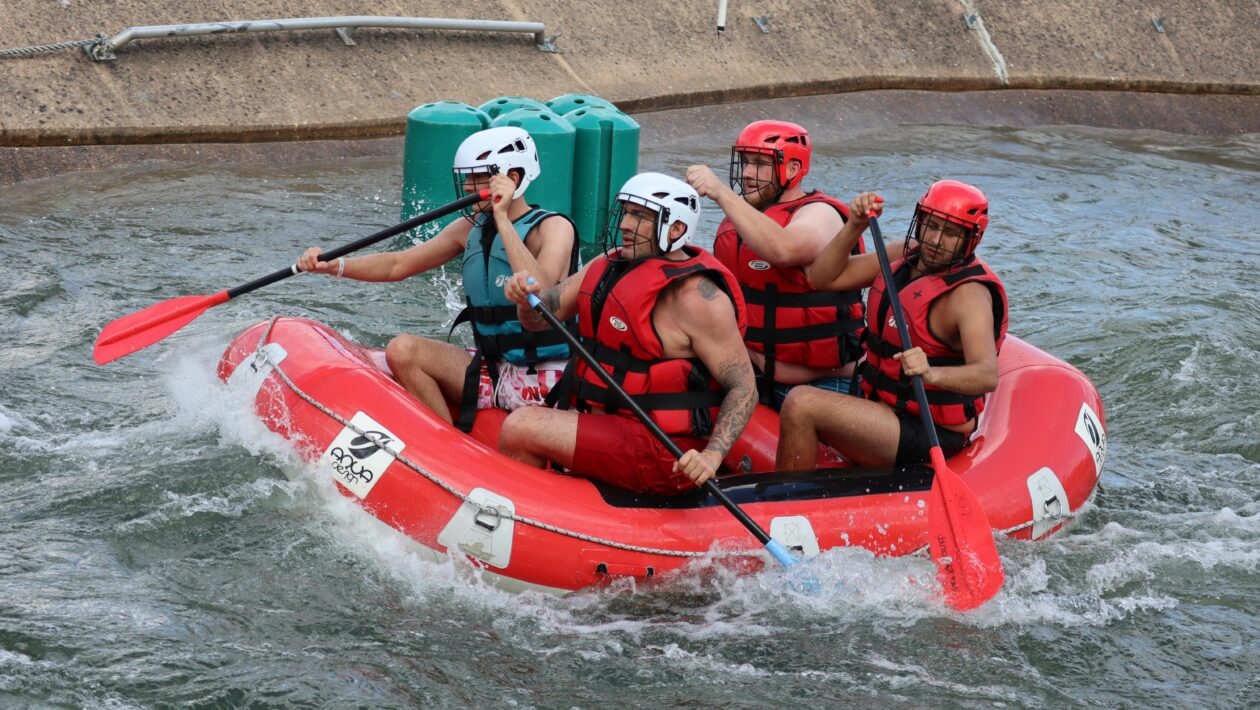
If you are looking to trade the smell of sanitizer for fresh spray and adrenaline, booking a whitewater rafting trip is one of the most efficient ways to shock your system. It is a common misconception that the river does all the work while you just hang on for the ride. The reality is quite the opposite. When you are navigating Class IV or V rapids, you are engaging in a high-intensity, full-body interval workout that torches calories and builds muscle in ways a stationary bike simply cannot match.
Here is the physiological breakdown of what happens to your body when you grab a paddle and push off from the shore.
1. Core
Most people think paddling is an arm workout. If you are doing it right, it’s actually an abs workout. Think about the mechanics of a raft. You are sitting on an inflated rubber tube that is bouncing violently over rocks, dropping into holes, and spinning in eddies. The boat is never flat. To keep from falling out, your body has to constantly micro-adjust. Your obliques, rectus abdominis, and lower back muscles are firing non-stop to keep your torso upright. You aren’t holding a static plank; you are bracing against unpredictable forces.
Furthermore, the paddle stroke itself is a rotational movement. You don’t pull with your bicep; you twist with your core. You reach forward, plant the blade, and untwist your torso to generate power. This repetitive twisting motion under resistance is essentially a dynamic twist or woodchopper exercise, done hundreds of times an hour. It sculpts the midsection more effectively than crunches because it is functional strength applied in an unstable environment.
2. Upper Body
While the core drives the motion, the upper body transfers that power to the water. Water is heavy. It is roughly 800 times denser than air. When you stick a paddle into a rushing current, the resistance is massive. Every stroke engages the “posterior chain” of your upper body.
- Lats (Latissimus Dorsi): These are the big wing muscles in your back. They do the heavy lifting of pulling the paddle toward you.
- Shoulders (Deltoids): Your shoulders are constantly active, lifting the paddle out of the water and positioning it for the next stroke.
- Grip Strength: You are holding onto that T-grip for dear life. If you let go, you might hit your teammate (or lose your teeth). This constant tension builds immense forearm endurance and grip strength, which is often a weak point for gym-goers.
Unlike lifting a dumbbell, where the weight is consistent, the river is variable. One stroke might slice through foam (easy), and the next might hit a wall of water (heavy). Your muscles have to instantly adapt to the load, building a type of resilient strength that looks good but performs even better.
3. Lower Body
This is the part that surprises first-timers the most. “Why are my legs sore?” In a raft, you aren’t just sitting on a bench like you’re at a bus stop. You are wedged in. Usually, your feet are tucked under a thwart (the cross-tubes of the raft) or hooked into foot cups. When the boat hits a drop or slams into a wave, the kinetic energy tries to launch you overboard. Your legs are the anchor. You are constantly driving your feet into the floor and squeezing the thwarts with your thighs to stay put.
It is basically a sustained isometric squat. Your quads, hamstrings, and glutes are under constant tension to lock your body to the boat. Additionally, when the guide calls for “High Side!” (meaning everyone needs to jump to one side of the boat to prevent a flip), you are performing an explosive plyometric movement. You have to launch your body weight across the raft instantly. That requires explosive power from the hips and legs.
4. The Cardio Factor
Rafting is the original HIIT workout. Rivers don’t flow at a constant difficulty. They have pools (rest periods) and rapids (work periods).
- The Sprint: You hear the roar of the water ahead. The guide screams, “ALL AHEAD FAST!” For 45 to 90 seconds, you are paddling at 100% max effort. Your heart rate spikes. You are anaerobic, burning sugar for fuel.
- The Recovery: You hit the calm pool at the bottom. You drift. Your heart rate comes down. You breathe.
This cycle repeats all day. Research shows that HIIT is one of the most effective ways to burn fat and improve cardiovascular endurance because it creates an afterburn effect. Your metabolism stays elevated for hours after you get off the river as your body tries to recover from those intense bursts of energy. Plus, there is the adrenaline factor. Even when you aren’t paddling hard, the sheer excitement and anticipation of the rapid raises your heart rate, burning additional calories just by being nervous!
5. The Mental Workout
Finally, there is the brain. Running a treadmill requires almost zero cognitive load. You can zone out. Running a river requires hyper-focus. You have to listen to commands, read the water, time your strokes with your teammates, and react to obstacles. This engages your proprioception (your body’s ability to sense its position in space). You are constantly calculating: Lean left. Duck right. Dig deep. Back paddle. You can’t think about your emails or your mortgage. You are 100% present. This mental reset lowers cortisol (stress hormones) levels, which is just as important for your physical health as the calorie burn.
Fitness and Adventure
We often separate fun from fitness. We think workouts have to be suffering, and weekends are for relaxing. Whitewater rafting proves that you can have both. You can have a wild, laughter-filled adventure with your friends that also happens to be a grueling physical challenge. You will wake up the next morning sore in places you didn’t know you had muscles—your thumbs, your obliques, your inner thighs. But unlike the soreness from a gym session, this pain comes with a memory of conquering a river. So, skip the leg day. Go find a Class IV rapid instead. The river doesn’t care how much you can bench press, but it will definitely teach you how strong you really are.