
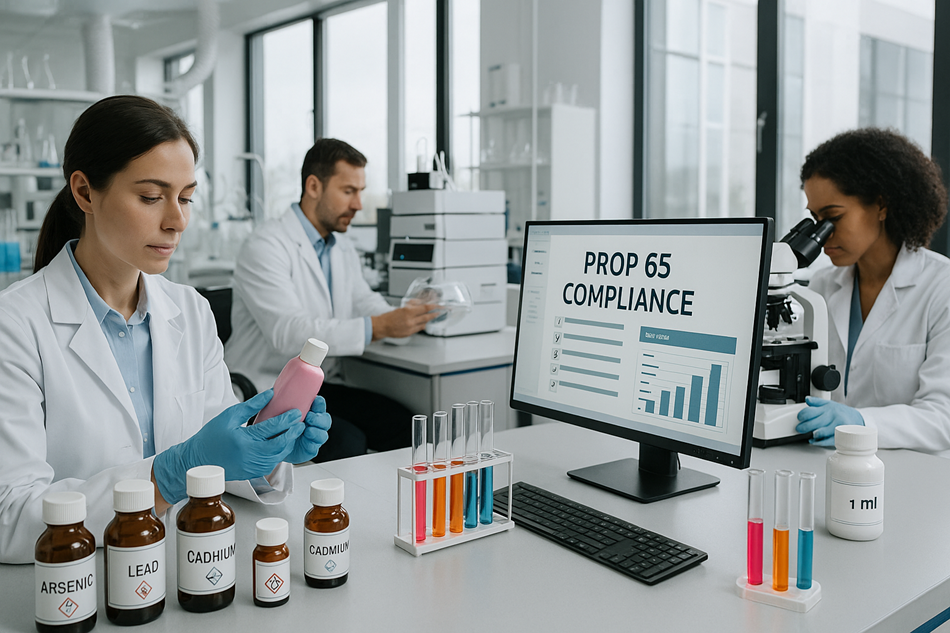
A company getting ready to launch a product in California may find itself facing a challenge it hadn’t anticipated: Proposition 65. For many businesses, this law feels like a complicated barrier. For scientists and testing laboratories, it is a safeguard designed to protect people from exposure to harmful chemicals.
The path to compliance is not always straightforward, but it is essential. Proposition 65, also called the Safe Drinking Water and Toxic Enforcement Act, has reshaped the way companies approach product safety. It influences industries from cosmetics to food, furniture to electronics, and its impact reaches far beyond California.
To understand how to navigate this requirement, it helps to break down what Prop 65 entails, how testing is carried out, and why chemistry is central to identifying both risks and safer solutions.
What Is Proposition 65?
Passed in 1986, Proposition 65 was created to protect California residents from exposure to substances that could cause cancer, birth defects, or other reproductive harm. The law requires businesses to provide “clear and reasonable warnings” when their products expose people to chemicals on the state’s list of concerns.
That list, managed by the Office of Environmental Health Hazard Assessment (OEHHA), is updated regularly and today includes over 900 chemicals. Additions are based on independent scientific studies, evaluations by authoritative bodies, and state-level assessments. The range is broad—covering everything from lead and cadmium to phthalates, solvents, and pesticides.
For businesses, Prop 65 is not a minor detail. California represents one of the largest consumer markets in the world. Compliance in this state often shapes a company’s national, and sometimes even global, approach to safety.
Understanding the Chemicals on the Prop 65 List
The chemicals on the Prop 65 list are diverse in both origin and effect. Some occur naturally in the environment, such as arsenic in soil. Others are synthetic and widely used in manufacturing.
Heavy metals like lead, mercury, cadmium, and hexavalent chromium remain a frequent concern. They are persistent in the environment and harmful even at very low concentrations. Phthalates, often used to make plastics flexible, have been restricted due to their links to reproductive harm. Volatile organic compounds (VOCs), found in solvents, paints, and adhesives, also appear on the list.
Safe harbor levels help businesses determine how much of a substance is considered acceptable. These benchmarks fall into two categories:
- No Significant Risk Levels (NSRLs): thresholds for carcinogens.
- Maximum Allowable Dose Levels (MADLs): thresholds for reproductive toxicants.
If exposure from a product falls below these levels, no warning is required. If it exceeds them, a Prop 65 warning label becomes necessary.
Common Consumer Products That Require Prop 65 Testing
The reach of this law is extensive, touching many categories of consumer goods.
Cosmetics and personal care items are frequently tested for heavy metals in pigments, phthalates in packaging, or formaldehyde-releasing preservatives. Food and dietary supplements undergo testing for contaminants like arsenic, lead, and acrylamide.
Electronics and household goods are examined for flame retardants, solvents, and heavy metals that may be present in plastics or coatings. Even furniture and children’s toys must be scrutinized for chemicals such as phthalates and formaldehyde.
The diversity of products affected is one reason why Prop 65 testing is not an optional step for companies entering California—it is a necessity.
What Prop 65 Testing Involves
Prop 65 testing is not a single standardized test. Instead, it involves a suite of analytical techniques chosen to detect specific chemicals in specific types of products.
For heavy metals, inductively coupled plasma mass spectrometry (ICP-MS) is often used. This method allows for the detection of elements like lead and cadmium at parts-per-billion levels.
For organic compounds such as phthalates or solvents, gas chromatography-mass spectrometry (GC-MS) provides the necessary sensitivity and specificity. High-performance liquid chromatography (HPLC) is used to analyze other organic contaminants, including certain pesticides.
The process begins with sample preparation—sometimes as simple as digesting a food product in acid, other times requiring extraction from complex materials like plastics or cosmetics. Once analyzed, the results are compared against OEHHA’s safe harbor levels.
When a chemical does not have an established safe harbor level, risk assessments are required. This involves evaluating toxicological data and estimating consumer exposure to determine whether a warning label is necessary.
The Compliance Side of Prop 65
Prop 65 is not just a scientific exercise. It is also a legal framework with serious consequences for businesses that fail to comply.
Non-compliance can lead to civil penalties of up to $2,500 per day, per violation. In addition, companies risk lawsuits filed by private enforcers—law firms and organizations that actively pursue alleged violations. These lawsuits can be costly, not only in financial terms but also in damage to brand reputation.
For businesses, there are two main options when testing reveals chemical levels above safe harbor thresholds. The first is to reformulate the product to eliminate or reduce the problematic substance. The second is to provide a clear Prop 65 warning label.
Reformulation is often the preferred choice, as it avoids the stigma associated with warning labels and demonstrates a commitment to safety. However, reformulation can be technically complex and costly. This is where testing laboratories and scientific expertise become indispensable.
How Chemistry and Innovation Drive Safer Products
The search for safer alternatives is a field of constant innovation. Chemistry plays a pivotal role in identifying replacement ingredients and designing products that perform well without relying on harmful substances.
Plasticizers provide a clear example. Traditional phthalates have been replaced in many applications with newer, safer compounds that offer similar flexibility without the same health concerns.
In cosmetics, heavy metal pigments are being phased out in favor of safer mineral-based or synthetic alternatives. Paints and adhesives have evolved to incorporate low-VOC or water-based solvents, reducing risks of exposure both during manufacturing and consumer use.
Each of these advancements is possible because chemistry provides not just the tools to detect hazards but also the knowledge to engineer better solutions.
How Qalitex Supports Prop 65 Testing and Compliance
At Qalitex, we understand that accuracy is non-negotiable when it comes to Prop 65 testing. Our laboratories are equipped with advanced instrumentation, from ICP-MS for heavy metal detection to GC-MS and HPLC for organic contaminants. These methods ensure that even trace levels of regulated substances can be identified with confidence.
Guidance on Reformulation and Safer Alternatives
Testing alone is not enough. Many companies need guidance on what to do when results point to compliance risks. At Qalitex, we work with clients to evaluate reformulation strategies and identify safer substitutes for ingredients of concern. Our scientists bring not only technical expertise but also practical insight into balancing safety, performance, and cost.
Ensuring Global Compliance Confidence
While Prop 65 is specific to California, companies rarely operate in just one market. That is why Qalitex aligns testing with broader regulatory frameworks, including FDA requirements and European REACH standards.
This global perspective helps businesses streamline compliance, reduce duplication of testing, and expand confidently into new regions.
Building Long-Term Trust
Our role extends beyond compliance. By helping companies demonstrate a proactive commitment to safety, we support their efforts to build consumer trust. Prop 65 testing, when approached strategically, becomes not just a regulatory requirement but a mark of credibility.
Final Thoughts
Proposition 65 is a complex law, but its purpose is straightforward: protecting people from harmful chemical exposures. For businesses, compliance may feel like a challenge, but it is also an opportunity to align with higher safety standards and strengthen consumer trust.
Prop 65 testing is about understanding products at the molecular level, identifying potential risks, and making informed choices about formulation and labeling. Chemistry, innovation, and rigorous testing are the tools that make this possible.
For companies willing to embrace these tools—and for those that partner with laboratories experienced in Prop 65 testing—compliance does more than keep them out of legal trouble. It positions them as leaders in safety, responsibility, and consumer care.