
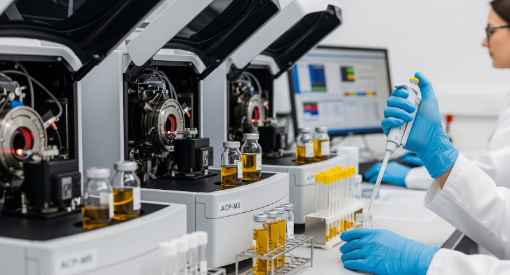
Not all contaminants are visible. In the nutraceutical industry, heavy metals quietly pose one of the most persistent and dangerous risks to consumer safety, especially when supply chains stretch across borders and raw ingredients vary in quality.
This article breaks down why heavy metals are a critical concern, where current industry testing falls short, and how advanced methods, like those used at Ayah Labs, can close those gaps.
Why Heavy Metals Are a Nutraceutical Industry Concern
Heavy metals like lead, mercury, cadmium, and arsenic can contaminate nutraceutical products through soil, water, air, and processing materials. These metals don’t degrade over time and can accumulate in the human body, posing significant health risks when consumed chronically, even in trace amounts.
For manufacturers of supplements and herbal remedies, this means the presence of heavy metals can undermine both safety claims and regulatory compliance. The challenge is especially pronounced with plant-derived ingredients, which often come from regions with unregulated or contaminated agricultural practices.
How contamination enters the supply chain
From soil to capsule, here’s how heavy metals make their way into finished products:
- Agricultural uptake: Plants absorb heavy metals from contaminated soil and water.
- Water sources: Irrigation with polluted water can increase metal concentrations.
- Processing materials: Equipment or storage vessels made with poor-quality alloys.
- Transportation and packaging: Exposure to industrial environments or contaminated packaging materials.
Even manufacturers committed to clean sourcing can find themselves dealing with contamination introduced at any point along the way.
Global and U.S. Regulations on Heavy Metals in Supplements
Testing for heavy metals is a regulatory expectation. Various national and international bodies set limits on the allowable levels of heavy metals in ingestible products. However, these limits are not always consistent.
This section outlines key regulations shaping testing expectations for nutraceutical brands and manufacturers.
Understanding FDA guidance and limits
The U.S. Food and Drug Administration (FDA) doesn’t set a unified limit for all heavy metals in all supplements. Instead, it issues guidance documents for specific product types, such as:
- Maximum daily intake recommendations (e.g., 10 mcg/day for lead in dietary supplements).
- Toxicological risk assessments for vulnerable groups like children and pregnant women.
- The Closer to Zero initiative targeting metals in foods and dietary products consumed by infants and children.
Compliance isn’t always mandatory, but it is critical to product safety and risk mitigation.
The impact of California Proposition 65
California’s Prop 65 requires businesses to warn consumers about significant exposures to chemicals that cause cancer, birth defects, or reproductive harm, including heavy metals.
- Strict limits: For example, Prop 65 sets a daily limit for lead at 0.5 micrograms, much lower than federal guidelines.
- Litigation risks: Failure to comply has led to costly lawsuits and mandatory reformulation.
- Labeling demands: Even trace levels may require a warning label in California, depending on exposure calculations.
For brands selling nationwide, Prop 65 often becomes the de facto national standard.
How international guidelines compare
Other global standards often align with or diverge from U.S. limits:
- European Union (EU): Sets maximum levels of heavy metals in foods and supplements under EC Regulation 1881/2006.
- World Health Organization (WHO): Publishes guidance for permissible levels in herbal medicines.
- Canada’s NNHPD: Enforces strict heavy metal limits for natural health products under its own published guidelines.
Navigating these multiple frameworks can be overwhelming for companies scaling internationally.
Common Industry Gaps and Pitfalls in Heavy Metal Testing
Despite the availability of advanced testing methods, many brands fall short when it comes to consistent, accurate screening for heavy metals.
Here’s where the industry tends to go wrong and why those gaps matter.
Assuming suppliers’ COAs are enough
Too often, manufacturers rely on Certificates of Analysis provided by raw material vendors without verifying them through independent labs. This creates several risks:
- COAs may reflect batch averages, not specific shipments.
- Testing methods used by suppliers may not meet regulatory standards.
- There’s little to no transparency on how samples were collected or analyzed.
Irregular or insufficient testing frequencies
Some brands only test raw materials once a year or worse, not at all after initial onboarding. This approach ignores the variability in natural products and introduces serious quality control blind spots.
- Different harvests = different contamination levels.
- New suppliers = new unknowns in quality assurance.
Routine testing of every lot or batch is the only way to identify issues before products reach consumers.
Misunderstanding what “organic” or “natural” guarantees
There’s a dangerous misconception that organic or natural products are automatically free from contaminants. In reality:
- Organic certification focuses on pesticides, not heavy metals.
- Soil in “organic” farms can still contain lead or arsenic from industrial history.
Without testing, claims of purity are just marketing.
Testing Methodologies and Scientific Rigor
When it comes to detecting heavy metals, the accuracy and sensitivity of the chosen analytical method can make or break the result. At the high-precision level required for compliance and safety, not all methods perform equally.
This section outlines the most widely used testing technologies and the reasons behind the choices made by science-focused labs like Ayah Labs.
Why ICP-MS is considered the gold standard
Inductively Coupled Plasma Mass Spectrometry (ICP-MS) is the preferred method for trace metal analysis across pharmaceutical and nutraceutical applications. Here’s why:
- Extremely low detection limits: Can measure metals down to parts per trillion.
- High sensitivity: Accurately distinguishes between isotopes.
- Wide dynamic range: Works for both trace and high concentrations.
- Multi-element capability: Can detect multiple metals in one run.
Compared to AAS (Atomic Absorption Spectroscopy) or ICP-OES (Optical Emission Spectroscopy), ICP-MS offers superior precision and reproducibility for critical applications.
The importance of validated sample prep
Proper sample digestion is just as important as the instrument used. Inconsistent or incomplete digestion can skew results and underreport true contamination levels.
Effective labs ensure:
- Matrix-specific methods: Tailored digestion based on product type (e.g., capsule vs. powder).
- Controlled reagent use: To prevent dilution or contamination.
- Validated protocols: To meet regulatory and accreditation standards.
Sensitivity, specificity, and real-world accuracy
Detection isn’t enough; results need to be both specific and actionable. That means:
- Confirming the metal type and oxidation state.
- Distinguishing between biologically active and inert forms.
- Reporting in a format aligned with regulatory frameworks.
How Ayah Labs Screens for Heavy Metals
Accurate heavy metal detection starts with the right methodology, but ends with execution. At Ayah Labs, every element of their testing process is designed around traceability, repeatability, and real-world relevance.
They work closely with nutraceutical manufacturers, formulators, and ingredient suppliers to screen for lead, arsenic, cadmium, mercury, and other elemental contaminants using validated methods built for complex botanical and nutritional matrices.
Their use of ICP-MS and matrix-specific methods
They use ICP-MS (Inductively Coupled Plasma Mass Spectrometry) as their core technology for heavy metal testing. Unlike generic testing that assumes a one-size-fits-all approach, they tailor their workflows depending on the sample type, whether it’s a protein powder, botanical capsule, gummy, or tincture.
- Sample digestion methods are adjusted based on oil, powder, or extract consistency.
- Their in-house validation protocols ensure that metals aren’t masked by the product’s composition.
- Results include Limits of Detection (LOD) and Limits of Quantification (LOQ), clearly reported for client use.
Compliance with ISO/IEC 17025 principles
Even when the test itself is robust, the quality of the lab performing it matters. At Ayah Labs, they follow ISO/IEC 17025 principles, meaning all equipment is calibrated, all analysts are trained, and all results are traceable from sample intake to final report.
- Chain-of-custody procedures ensure sample integrity.
- Each test includes quality control checkpoints: blanks, spikes, and duplicates.
- Methods undergo internal audits and are aligned with applicable regulatory standards.
Reporting Standards and Client Transparency
They believe that analytical data is only valuable if the client knows how to use it. Their reporting format is deliberately clear, devoid of unnecessary jargon, and structured to empower informed decisions.
Whether you’re a regulatory specialist or a product developer, you won’t need to decode their reports.
Reporting what matters, not just numbers
Every Ayah Labs metals report includes:
- Test method and version used
- LOD/LOQ for each element
- Result per analyte (in ppm or µg/g)
- Regulatory reference comparisons (e.g., FDA, Prop 65, EU)
Optional risk assessments are available upon request to interpret results based on dosage, exposure, and product use case.
Consultations and follow-ups available
They don’t send results and disappear. When a result needs context or a corrective path forward, they offer consultation calls with their technical team.
- Planning for batch retesting or reformulation
- Investigating contamination origin
- Creating a heavy metal monitoring plan for future production
That ongoing support is part of why brands stay with Ayah Labs over the long term.
Addressing Industry Challenges with Science-Driven Solutions
Testing is a necessary step, but it’s not the endpoint. The ultimate goal is risk mitigation and continuous quality improvement. Ayah Labs helps clients think beyond the test result, addressing broader challenges in sourcing, formulation, and compliance.
Here’s how that support translates into action.
Proactively preparing for Prop 65 enforcement
They regularly help clients calculate exposure levels to determine if Prop 65 warnings are required. Where risks are identified, they assist in:
- Reformulation strategies to reduce metal loads
- Supplier audits to trace and correct contamination
- Documenting due diligence to minimize legal exposure
In the current legal climate, being proactive is often the best form of protection.
R&D support for cleaner formulations
Nutraceutical innovation is moving fast, but without proper testing, novel ingredients can bring hidden risks. They support R&D teams with:
- Screening new ingredients before inclusion
- Testing during pilot batches
- Advising on ingredient substitution based on toxicity profiles
This helps clients avoid costly reformulations after launch.
Problem-solving for batch failures
When a batch fails for heavy metals, it’s not always clear why. We’ve helped manufacturers pinpoint issues such as:
- Supplier inconsistency
- Cross-contamination during production
- Mislabeling of “wild” versus cultivated ingredients
By identifying the root cause, they help prevent future failures – saving time, money, and brand reputation.
Why Testing with Ayah Labs Goes Beyond Compliance
At its core, heavy metal testing is about protecting human health. But for Ayah Labs, it’s also about science done right. The Chicago-based quality testing laboratory was founded on the belief that analytical testing should support – not hinder – product innovation.
They go beyond box-checking to be a true partner in the product lifecycle.
A culture of science-first accuracy
From their Chicago-based lab, they serve clients across North America who trust them to be precise, fast, and transparent. Every analyst on their team is trained in ISO-based protocols and industry-specific nuances.
- Their team includes chemists, microbiologists, and compliance experts.
- They regularly update their methods to align with evolving regulations.
- Custom test development is available for novel product types.
If you’re producing or planning to launch nutraceutical products and want to be confident in your heavy metal safety profile, Ayah Labs is ready to help. Schedule a consultation with their scientific team to discuss your project, testing needs, and how they can support your quality goals.