
Two scientific papers can investigate molecules from the same broad family and reach results that sound equally promising. One may report a measurable biological effect in laboratory cells. Another may document outcomes in a large randomized human trial. Both findings can be legitimate, yet they provide very different levels of confidence about what the molecules actually do.
This distinction is especially important in peptide science. The word “peptide” identifies a broad chemical category, not a uniform class of medicines or research materials with interchangeable properties. Peptides differ in amino acid sequence, molecular structure, biological targets, chemical stability and the evidence available to explain their behavior.
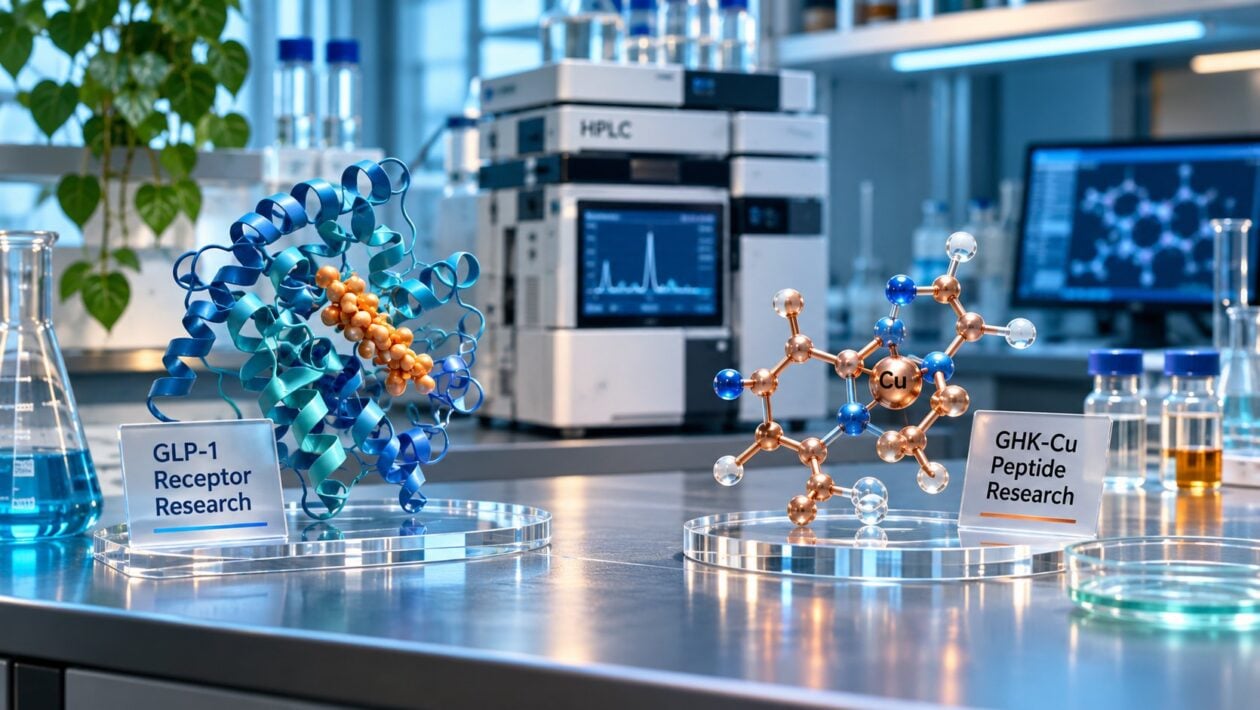
Semaglutide and the copper-binding peptide GHK-Cu illustrate the problem particularly well. They appear in overlapping discussions about metabolism, cellular biology and emerging biomedical research, but their scientific histories follow different paths. Examining both reveals how researchers should distinguish molecular mechanisms, experimental observations and established clinical findings.
Why Sharing a Chemical Category Does Not Mean Sharing the Same Evidence
Peptides consist of amino acids joined through peptide bonds. Their biological properties depend on more than the number of amino acids they contain. Changes in molecular sequence, chemical modifications, binding partners and environmental conditions can substantially alter how an individual peptide behaves.
Some naturally occurring peptides function as hormones or signaling molecules. Others participate in structural or regulatory processes. Synthetic compounds may be designed to interact with particular receptors or to remain chemically stable under conditions where naturally occurring molecules would degrade.
These differences mean that findings about one peptide cannot simply be transferred to another. Evidence of receptor activity in one experimental model does not establish that a different peptide will produce a comparable effect, even when both are discussed within the same research field.
Educational materials such as Peptides Newark research resources can provide a starting point for exploring individual compounds and the terminology surrounding them. Any scientific claim, however, still needs to be checked against the underlying research, including the methods used and the limitations reported by investigators.
A reliable interpretation begins by identifying precisely which molecule was studied, what researchers measured and whether the results came from purified chemistry experiments, laboratory cells, animals or human participants.
Semaglutide: When Molecular Research Progresses Into Clinical Evidence
Semaglutide is a glucagon-like peptide-1 receptor agonist. GLP-1 is involved in physiological signaling related to glucose regulation and other metabolic processes. Understanding this signaling pathway helped scientists investigate compounds capable of interacting with the GLP-1 receptor.
Research into receptor behavior provides information about how a compound may produce biological effects. Investigators can examine receptor binding, downstream signaling and physiological responses under controlled conditions. These experiments establish a mechanistic foundation, but they are only part of the evaluation.
Semaglutide subsequently underwent extensive clinical investigation. Specific semaglutide-containing medicines received approval from the United States Food and Drug Administration for defined indications after regulatory review of relevant evidence.
The FDA’s 2026 prescribing information for Ozempic identifies approved uses related to type 2 diabetes, certain cardiovascular outcomes and chronic kidney disease in specified patient populations. Wegovy has its own approved indications and product-specific labeling. The names, formulations and indications must be distinguished rather than described as one unrestricted approval for every semaglutide-containing product.
Readers exploring semaglutide research should therefore distinguish basic GLP-1 receptor science from evidence generated in regulated clinical development. A mechanistic explanation describes how a biological response may occur. A controlled clinical trial examines defined outcomes in a particular population under a specified study design.
Even strong clinical evidence is not a blanket claim about every formulation, population or research material. Approval is specific to the evaluated product and its authorized indications. A chemical label or laboratory purity figure alone does not establish equivalence to an approved medicine.
GHK-Cu: A Different Research Pathway With More Unanswered Questions
GHK-Cu refers to a copper-associated complex of the tripeptide glycyl-L-histidyl-L-lysine. The relationship between the peptide and copper is central to its chemistry, making the identity of the investigated material especially important.
Researchers have examined GHK-related systems in studies of extracellular matrix biology, cellular responses, inflammatory signaling and tissue-repair mechanisms. Some experimental findings suggest biologically interesting activity, particularly in cellular and preclinical models.
That research is not equivalent to a large body of confirmatory human clinical evidence. A 2026 review published in Pharmaceutics examined GHK-Cu as both a bioactive metallopeptide and a formulation-dependent material. The authors emphasized that the clinical literature remains limited and that the chemical identity of materials used in studies is frequently characterized inadequately.
This creates two separate questions. First, does an observed biological effect hold up under rigorous experimental controls? Second, was the actual copper-peptide species studied sufficiently defined to make the result interpretable or reproducible?
Investigations of GHK-Cu research need to account for both questions. The amount and chemical state of copper, the distinction between free peptide and copper-bound material, and the conditions under which the sample was prepared can affect scientific interpretation.
Historical cosmetic studies and recent small controlled investigations have produced findings worth studying further. However, a small study with an incompletely defined test material cannot justify broad assertions about effectiveness or safety across unrelated applications.
The difference between GHK-Cu and semaglutide is therefore not simply that one compound is more interesting than another. They have different evidence profiles, different chemical considerations and different levels of regulatory evaluation.
What a Laboratory Result Can Establish and What It Cannot
Laboratory experiments often answer narrowly defined questions. Researchers might measure whether a compound interacts with a receptor, whether a particular gene-expression pattern changes or whether cells respond differently after exposure under controlled conditions.
Those measurements can be scientifically useful without establishing a benefit in humans. Cell cultures simplify complex biological systems. Animal models introduce additional physiological processes, but they still cannot reproduce every feature of human biology.
A positive laboratory result also depends on the validity of the measurement itself. Researchers must consider contamination, sample identification, analytical sensitivity, controls and whether the selected endpoint accurately represents the proposed biological mechanism.
For example, an increase in a molecular marker might be consistent with a hypothesized pathway. It does not automatically establish that tissue function improved or that a clinical outcome would change. Researchers need additional experiments to connect the initial observation with meaningful downstream effects.
Peer review can identify problems before publication, but it does not eliminate every uncertainty. Independent replication, transparent methods and clear descriptions of experimental limitations remain necessary after a paper enters the scientific literature.
The Analytical Chemistry Problem Behind Peptide Comparisons
Before researchers can interpret the biological activity of a peptide sample, they must establish what the sample actually contains. An inaccurate material description can compromise an otherwise carefully designed experiment.
High-performance liquid chromatography, or HPLC, is frequently used to examine chromatographic composition. It can help separate components and estimate relative purity under specified analytical conditions. However, chromatographic purity is not the same as comprehensive molecular identification.
Mass spectrometry can provide complementary information about molecular mass and identity. Depending on the compound, laboratories may require additional analytical approaches to distinguish closely related species, confirm structural features or evaluate chemical modifications.
GHK-Cu offers a particularly useful example because copper association introduces further questions about chemical speciation. A report that identifies the underlying peptide does not necessarily establish the proportion present as the intended copper-bound complex.
Similarly, a laboratory result associated with semaglutide should not be presented as evidence that an independently obtained research sample possesses the manufacturing controls, pharmaceutical properties or clinical evidence of an FDA-approved product.
Reliable analytical reporting should identify the material, describe the relevant methods, explain their limitations and connect the findings to a specific batch or experimental sample.
Why Study Design Matters More Than an Impressive Headline
A scientific headline can describe a true experimental observation while leaving out information needed to interpret it. A reported percentage change may appear substantial until readers examine the sample size, measurement variability and comparison group.
In preclinical research, investigators should ask whether experiments included appropriate negative and positive controls. They should also examine whether outcome measurements were prespecified and whether independent repetitions produced consistent results.
Human trials introduce further requirements. Randomization, appropriate comparison groups, blinding, clearly defined outcomes and sufficient statistical power can help reduce bias and distinguish a genuine effect from random variation.
Not every scientific question requires the same study design. A chemical identification experiment has different objectives from a clinical trial. The important issue is whether the methods can support the conclusion being presented.
A laboratory paper should not be criticized simply because it did not include human participants when its stated purpose was to characterize a molecule. Problems arise when later summaries extend its conclusions beyond what the original methods could establish.
This distinction helps readers appreciate early scientific findings without treating them as evidence of an established clinical application.
How Regulatory Status Changes the Meaning of a Scientific Claim
Scientific evidence and regulatory authorization are related but distinct concepts. A medicine can have well-described mechanisms and positive clinical findings, yet its approved uses remain defined by the relevant regulator and product labeling.
Semaglutide demonstrates the importance of product-specific regulatory evaluation. The FDA has assessed particular manufactured semaglutide medicines for specified uses. That determination does not authorize every similarly named product, independently prepared material or proposed application.
GHK-Cu illustrates a different situation. Its preclinical and limited human literature can support continued investigation, but the existence of peer-reviewed research does not establish general approval as a medicine or prove clinical effectiveness.
The phrase “research use only” likewise describes an intended use or marketing designation. It does not independently demonstrate regulatory compliance, material quality, suitability for a given experiment or safety for human administration.
Responsible scientific writing should identify the relevant jurisdiction and distinguish investigational findings from authorized medical indications. Claims should also be revisited as new studies and regulatory decisions become available.
Five Questions That Improve the Interpretation of Peptide Research
Researchers, science writers and readers can apply a consistent evidence framework when comparing compounds with very different development histories.
Which exact material was studied? The molecular identity, chemical form and relevant formulation details need to match the claim being evaluated. A result involving one peptide complex should not automatically be assigned to another.
What experimental model produced the finding? A biochemical assay, isolated cell culture, animal experiment and randomized human trial answer different questions. The study model determines how far the conclusion can reasonably extend.
What outcome did investigators measure? Changes in molecular markers may help explain mechanisms, but they should not be confused with demonstrated improvements in human health outcomes.
Were the results independently supported? Replication, transparent reporting and comparisons across independent research groups help identify findings that depend heavily on one laboratory or analytical method.
What remains uncertain? Useful research reports clearly describe unanswered questions, methodological weaknesses and circumstances in which their findings may not apply.
These questions are especially helpful when the same general term, such as peptide research, is used to discuss compounds with entirely different levels of scientific and clinical validation.
Better Scientific Communication Starts With Precise Boundaries
The comparison between semaglutide and GHK-Cu demonstrates why peptide research cannot be evaluated as one uniform category. One molecule has undergone substantial product-specific clinical development and regulatory review. The other has a developing body of biochemical, preclinical and comparatively limited clinical research, with important unresolved questions about material characterization.
Neither evidence profile should be exaggerated or misrepresented. Established clinical findings deserve accurate descriptions of their scope, while preliminary laboratory observations deserve careful attention without promises they cannot yet support.
For scientific publishers and educational websites, the most useful approach is to name the studied compound precisely, identify the evidence level and explain the limitations before drawing broader conclusions.
That discipline allows readers to understand promising research while preserving the distinction between molecular discovery, reproducible scientific evidence and validated clinical applications.