
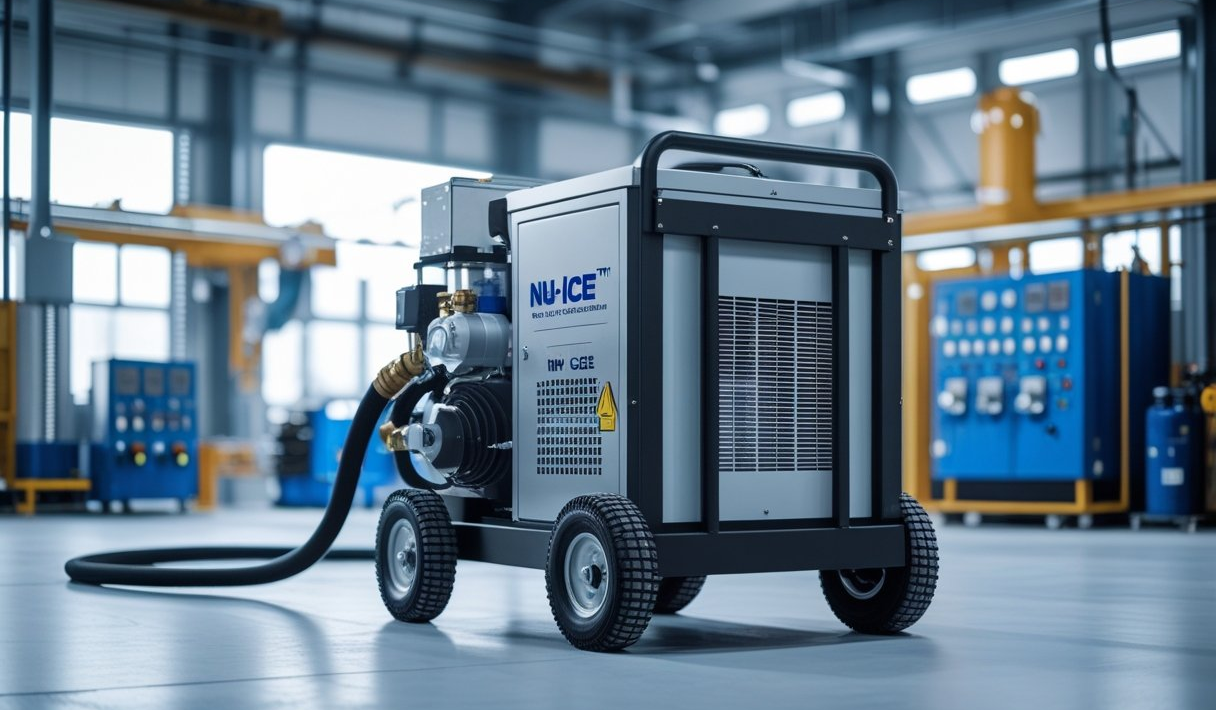
Industrial equipment in power plants often faces critical challenges such as residue buildup, heat exchanger fouling, and the risk of prolonged downtime during maintenance. Traditional methods—chemical cleaning, abrasives, or high-moisture solutions—can damage sensitive surfaces or delay operational restart. Nu-Ice™ Dry Ice Blasting offers a non-abrasive, moisture-free solution tailored for power generation environments. As a manufacturer of advanced dry ice blasting equipment, Nu-Ice™ specializes in industrial cleaning dry ice solutions that target turbine cleaning and condenser maintenance while minimizing operational interruptions. This dry ice blasting power plants method ensures thorough cleaning without secondary waste or damage, supporting high-efficiency uptime across facilities.
Dry ice blasting is a non-abrasive cleaning process that uses solid carbon dioxide (CO₂) pellets propelled by compressed air. These dry ice pellets are accelerated at high speed toward the surface being cleaned, dislodging contaminants through impact. Upon contact, the pellets rapidly transition from solid to gas in a process called sublimation. This phase change helps lift residues while leaving no liquid or solid secondary waste behind. Because there is no abrasive media or moisture involved, the process is well-suited for delicate equipment and environments requiring clean-in-place methods.
Kinetic Impact
During dry ice blasting, high-velocity dry ice pellets are accelerated through compressed air and directed at the target surface. When the pellets strike the contaminant layer, the kinetic energy generated by the impact helps loosen and fracture residues such as grease, coatings, carbon buildup, or biological material. This mechanical action disrupts surface bonds without relying on abrasive force, allowing contaminants to be removed while preserving the integrity of the underlying substrate. Because the pellets are relatively soft compared to traditional blasting media, the base material remains unaffected.
Thermal Shock
Dry ice pellets have an extremely low temperature of approximately -109°F (-78.5°C). When these pellets come into contact with warmer surface contaminants, a rapid temperature differential occurs. This sudden cooling causes contaminants to contract at a different rate than the surface beneath them, leading to cracking, embrittlement, and bond failure. The thermal shock effect further weakens adhesion, making residues easier to remove without chemical agents or mechanical abrasion.
Sublimation Expansion
Upon impact, dry ice pellets sublimate—transitioning directly from a solid to a gas. This phase change results in a rapid expansion in volume, which penetrates micro-crevices and surface irregularities. The expanding CO₂ gas lifts and dislodges loosened contaminants from the surface, including areas that may be difficult to access using conventional cleaning methods. Because sublimation leaves no solid or liquid residue, no secondary waste remains after cleaning.
A typical dry ice blasting system consists of several integrated components working together to deliver controlled cleaning performance. The air compressor supplies the pressurized air required to propel the dry ice pellets at high velocity. The dry ice hopper stores and feeds pellets into the system while maintaining temperature conditions that limit premature sublimation. A metering system regulates pellet flow to match application requirements, ensuring consistency and operator control. Finally, the hose and nozzle assembly directs the air-and-pellet mixture toward the target surface, allowing precise adjustment of spray pattern and impact intensity for a wide range of industrial cleaning scenarios.
Nu-Ice Dry Ice Blasting. is the manufacturer behind the Nu-Ice™ Dry Ice Blasting line of equipment. Founded in 1993, the company specializes in the design and production of industrial cleaning systems that utilize dry ice technology. All Nu-Ice™ equipment is manufactured in the United States, reflecting a commitment to domestic production and quality control. The company serves industries where dry ice blasting power plants and other specialized applications require clean, non-abrasive maintenance solutions. Its operations center on equipment development and support tailored to industrial environments across various sectors.
Nu-Ice™ dry ice blasters feature a durable blasting gun with a range of interchangeable nozzles to suit various cleaning scenarios and geometries. The nozzle options allow for adjustments in spray pattern and reach, accommodating surface type and access limitations. The equipment also includes an integrated moisture separator, which helps remove humidity from the compressed air supply to maintain consistent blasting performance. Additionally, an aftercooler is included in the system to lower the temperature of compressed air before it enters the blasting unit, reducing the chance of ice clumping and ensuring smooth pellet flow. These components work together to deliver operational reliability in demanding environments.
The Nu-Ice Commando 55™ dry ice blaster is designed for industrial-grade performance. It measures 43 inches long, 23 inches wide, and 42 inches high, with a dry weight of approximately 325 pounds. The onboard hopper can hold up to 55 pounds of dry ice pellets, allowing for extended operation. The unit operates with air flow ranging from 80 to 450 cubic feet per minute (CFM), supporting pressures between 60 and 250 pounds per square inch (PSI). Typical dry ice consumption is between 1.2 and 3.2 pounds per minute, depending on the application setting and nozzle configuration. These specifications reflect the machine’s capability for continuous, high-demand cleaning tasks in industrial environments.
Preparation and Setup
The process begins by connecting the Nu-Ice™ dry ice blasting unit to a compatible compressed air supply and ensuring the dry ice hopper is filled with pellets. Appropriate nozzle selection is based on the cleaning application.
Safety Requirements
Operators must wear protective equipment, including gloves, eye protection, and hearing protection. Proper ventilation is required in enclosed spaces to manage CO₂ gas levels from sublimation.
Typical Workflow Steps
Once powered on, the unit meters dry ice into the air stream and directs it through the hose and blasting nozzle. Operators move the nozzle over target surfaces to dislodge contaminants. After cleaning, the system is powered down, depressurized, and cleaned for storage.
Nu-Ice™ dry ice blasting equipment is used across a range of industries requiring precision cleaning. In manufacturing and production, it supports equipment maintenance without disassembly. In food processing, the system provides a hygienic, moisture-free method of removing buildup from conveyors, ovens, and molds. For historical restoration, it cleans sensitive materials like stone and brick without abrasion. The equipment is also applied in automotive detailing and aerospace maintenance where residue removal must avoid surface damage. In electrical and specialty cleaning applications, the non-conductive nature of dry ice allows safe cleaning of switchgear, panels, and other components without moisture introduction. These use cases highlight the broad utility of dry ice blasting in controlled industrial settings.
Dry ice blasting produces no secondary waste, as the dry ice sublimates on contact and leaves only the dislodged contaminant behind. It interacts non-abrasively with surfaces, preserving equipment integrity during repeated use. The process is dry and does not require chemicals, making it suitable for environments sensitive to moisture or residues. From an operational standpoint, dry ice must be handled with insulated gloves and stored in properly ventilated containers to avoid gas buildup. The use of dry ice blasting equipment supports industries seeking environmentally conscious, residue-free cleaning solutions, aligning with growing attention to dry ice blasting equipment efficiency and safety.
Nu-Ice™ offers a range of accessories designed to extend equipment capability and flexibility. Interchangeable nozzles and hose assemblies accommodate different cleaning angles, reach, and surface types. The system integrates with high-capacity air supplies and includes aftercoolers and moisture separators to ensure consistent dry pellet flow and prevent freeze-related clogging. Proper storage of dry ice is critical—insulated containers should be used to limit sublimation. Routine maintenance includes checking seals, inspecting hoses, and cleaning filters to preserve system performance and operational lifespan.
Frequently Asked Questions (FAQ)
What is dry ice blasting?
Dry ice blasting is a cleaning method that uses compressed air to accelerate solid CO₂ pellets onto surfaces, removing contaminants through impact and sublimation without leaving any moisture or residue.
Is the equipment compatible with standard air systems?
Nu-Ice™ dry ice blasting systems are compatible with standard industrial compressed air sources. Specific requirements for air volume and pressure are detailed in each model’s technical documentation.
What safety precautions are needed?
Operators must wear protective gloves, eye and hearing protection. Adequate ventilation is essential when using dry ice in enclosed spaces due to the buildup of carbon dioxide gas.
What setup is required for operation?
A typical setup requires a dry ice blasting unit, a reliable compressed air supply, and proper ventilation. Air drying components such as aftercoolers and separators are included to enhance system stability.
How does it compare to abrasive cleaning methods?
Unlike abrasive methods, dry ice blasting does not erode surfaces or generate secondary waste. It removes contaminants through physical impact and gas expansion, making it suitable for sensitive or coated materials.
What is the environmental impact of dry ice blasting?
Dry ice sublimates directly into carbon dioxide gas, leaving no solid or liquid waste. This makes the process environmentally favorable for industries seeking reduced cleanup and minimal chemical usage.
Nu-Ice Dry Ice Blasting continues to support industrial and commercial operators with U.S.-manufactured dry ice blasting systems engineered for precision and durability. With over three decades of operational focus and a commitment to clean, non-abrasive maintenance practices, the company remains a consistent provider of equipment for facilities requiring efficient, residue-free cleaning technologies. From power generation to manufacturing and preservation sectors, Nu-Ice™ equipment is used in environments where operational uptime and surface integrity are priorities.