
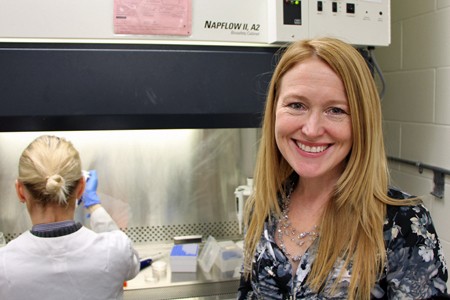
Dr. Lisa Porter is a cancer and cell biologist whose work sits at the intersection of discovery science, health innovation, and leadership. A Distinguished Professor of Biomedical Sciences at the University of Windsor, she connects fundamental research with real-world health impact. As the Founding Director of WE-SPARK Health Institute and through national service to the health research ecosystem, she has contributed meaningfully to improving health outcomes through partnership, advocacy, and engagement. Dr. Porter sits on the board of Research Canada, a national alliance dedicated to health research advocacy. Her recent work examines how a key protein influences stem cells and tumour growth, offering new insight into how cancers develop and progress in the brain.
___________
Q: Your research focuses on the molecular control of cell growth and division. Explain how this is critical to understanding diseases like cancer and neurological disorders.
DR. LISA PORTER: Diseases like cancer start inside the cell. When cells divide, there are thousands of things that have to be coordinated. They get their instructions from our DNA about when to divide, when to specialize, and when to stop. Cancer arises when those DNA controls fail, when our DNA changes in some way due to various factors like the environment, our own lifestyle choices, or things you can’t control like aging and your genetics. Genetics can protect you or make you more susceptible, which is why a lifetime smoker can live until a ripe old age while kids can be afflicted. When we study molecular mechanisms, we’re essentially looking at the instruction manual of the cell. Even small changes in how those instructions are followed can have enormous consequences. Understanding those processes gives us the opportunity to identify where things go wrong and, importantly, where we might intervene in a more targeted and effective way. This research creates the groundwork for future therapies, even if the applications aren’t immediate.
Q: Your recent work on brain health highlights the role of a specific protein in stem cells and tumour growth. What makes this discovery especially meaningful?
DR. LISA PORTER: What’s exciting about this research is that it connects two critical areas: normal brain function and disease. Stem cells are essential for maintaining and repairing tissues, including the brain. But when that regulation is disrupted, those cells can also contribute to tumour formation. In our work at the Porter Lab, my lab team, along with many other collaborators, has identified how a particular protein, Spy1, helps influence that balance by supporting normal stem cell behavior while also playing a role in tumour growth when misregulated. This gives us a clearer picture of how certain brain tumours may originate and why they can be so difficult to treat. It also raises important questions about how we might design future therapies that target cancer cells without harming healthy brain tissue. For patients and families, this kind of insight represents progress toward more precise and compassionate treatment strategies.
Q: You were the Founding Director of WE-SPARK Health Institute. How did that experience shape your perspective on research and impact?
DR. LISA PORTER: WE-SPARK is a powerful example of how science is fundamentally a team effort. We built the institute to bring together researchers, clinicians, industry partners, students, and community members across lots of disciplines and from many different countries. We wanted to break down borders and encourage people to think differently about pushing research forward. The work becomes so much stronger when diverse perspectives are included early and intentionally. When researchers understand the clinical realities, when patients feel heard, and when partners share a common goal, the outcomes are more relevant and more impactful. I continue to put a high value on creating effective collaborations in my own research and leadership.
Q: You’re also deeply involved at the national level through CIHR and Research Canada. Why does advocacy matter to scientists?
DR. LISA PORTER: Research can’t happen in isolation. Funding structures, peer review systems, and the priorities of a nation all shape what questions get asked and who gets to ask them. Through my roles with CIHR and on the Board of Research Canada, I’m able to contribute to conversations about how we support researchers, trainees, and institutions across the country. Advocacy matters because sustained investment in research is the best way to achieve better health outcomes, a stronger economy, and a more resilient society. Scientists have a responsibility not only to generate knowledge, but also to explain why that knowledge matters and how it benefits people. Being part of that broader dialogue is something I take very seriously.
Q: What continues to motivate you in a field that deals with complex and often devastating diseases?
DR. LISA PORTER: I’m motivated by the people who are both affected by and involved in the research and the work that we do. Whether it’s students who are discovering their passion for scientific research, colleagues who are tirelessly working and sharing ideas, or the patients and families whose lives are changed by the discoveries we’re making. Progress in research is rarely fast, and setbacks are part of the process, but every discovery adds to a greater collective effort. I’ve seen how building knowledge creates hope. When research is done thoughtfully and collaboratively, it can improve lives, strengthen communities, and create a future where devastating diseases are better understood, managed, and ultimately prevented.