
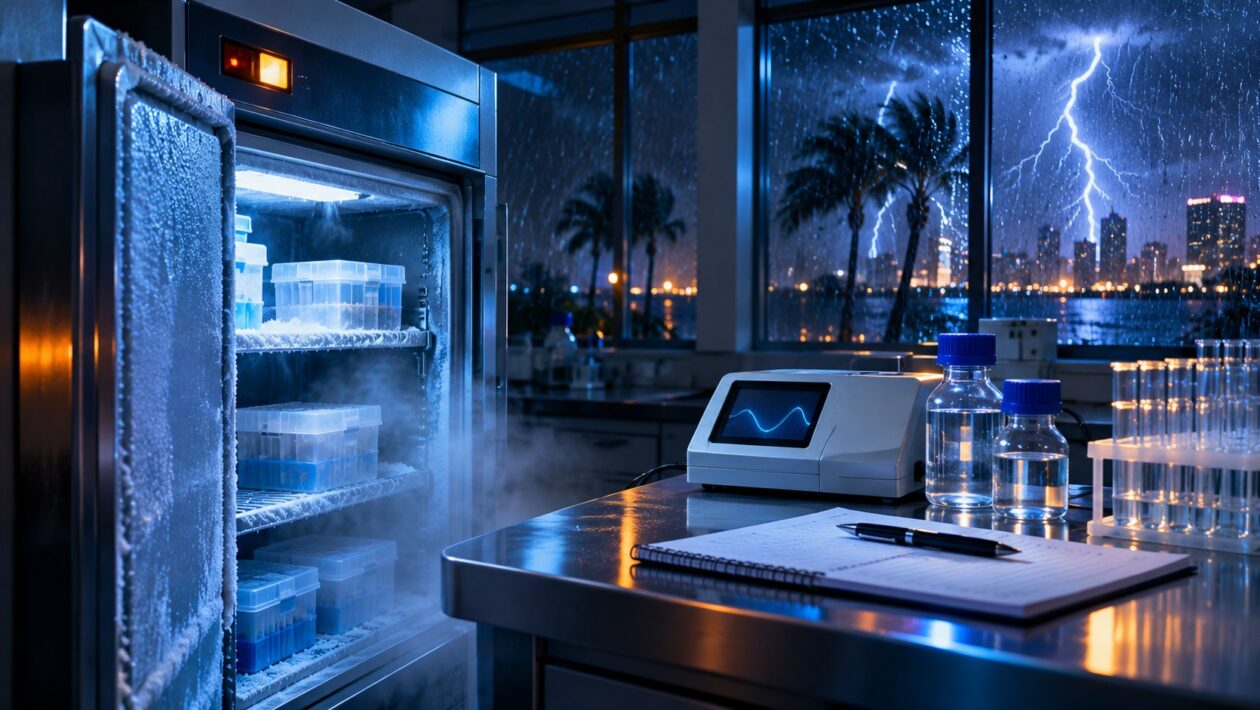
A severe coastal storm passes through South Florida overnight. In a hypothetical research facility, the building loses electricity for several hours. Emergency lighting comes on, but a freezer containing laboratory samples is not connected to backup power. When employees return, the containers are sealed, the labels are intact, and nothing appears visibly damaged.
It would be tempting to assume the samples survived the interruption.
That conclusion, however, raises a scientific question that visual inspection cannot answer: What happened to the material while the freezer was warming, and could those changes affect the next experiment?
A laboratory sample can look perfectly ordinary even when its chemical composition, physical structure or experimental suitability has changed. Depending on the material and its established stability characteristics, an interruption in controlled storage may create uncertainty that cannot be resolved by simply returning the samples to the freezer.
For scientists studying peptides and other biologically relevant molecules, a missing temperature record can sometimes be as consequential as a failed instrument reading. The problem is not merely whether the container survived. It is whether researchers still have a defensible basis for trusting the material inside.
The First Problem Is Not the Power Failure but the Missing History
After an interruption in laboratory refrigeration or freezing, staff need to understand the conditions experienced by the stored materials. The time electricity stopped, the duration of the interruption and the actual temperature inside the storage equipment are all potentially relevant.
Yet those facts are not always obvious from the time power was restored.
A freezer’s temperature does not necessarily change immediately when electricity stops. Its behavior depends on factors such as insulation, the number and arrangement of stored materials, surrounding room conditions and whether the door remained closed.
Two identical-looking containers may therefore have experienced different conditions if they were located in separate storage units or exposed to different environmental circumstances.
A useful investigation distinguishes what is documented from what is assumed. A building maintenance record might establish when an outage occurred, but it may not establish the temperature history of every sample.
Likewise, a display showing the correct temperature after power returns does not prove that the temperature remained within the specified range during the interruption.
This is why continuously recorded environmental information can be valuable. It helps investigators reconstruct the event rather than relying entirely on estimates made afterward.
What Scientists Mean by a Temperature Excursion
A temperature excursion occurs when material is exposed to conditions outside the storage range established for that material or product.
The term describes a deviation, not an automatic finding that the material has become unusable. The consequences depend on the substance, the extent and duration of exposure, and the scientific evidence available to assess potential changes.
Health Canada’s guidance on temperature control during drug storage and transportation explains that excursions may sometimes be acceptable when stability data and a sound scientific justification demonstrate that quality has not been adversely affected.
That principle does not mean every research sample has a universal acceptable excursion period. Different materials can have very different stability characteristics.
Some substances tolerate temporary departures from their preferred storage conditions. Others may be sensitive to changes that appear relatively minor. The mere fact that an interruption was brief cannot establish safety or continued fitness for research.
For an experimental sample lacking sufficient stability information, researchers may have little basis for deciding what the exposure actually meant.
Why a Clear Glass Vial Cannot Reveal Molecular Damage
Visual inspection remains useful for identifying obvious physical problems. A broken container, damaged closure, unexpected cloudiness or visible contamination can signal a need for investigation.
But appearance is not a comprehensive chemical test.
Changes at the molecular level may be invisible to the naked eye. Peptides, for example, can undergo chemical modifications under certain conditions. Depending on the molecule and its environment, investigators may need to consider processes such as oxidation, hydrolysis or other degradation pathways.
Some peptide-containing preparations can also experience physical changes, including aggregation or adsorption to surfaces. Which processes matter depends on the specific material and formulation.
None of these possibilities should be assumed to have occurred in every temperature excursion. Their relevance has to be established scientifically.
The important point is that a sample’s visible appearance cannot establish molecular identity, purity, structural integrity or the absence of degradation products.
A sealed vial may provide reassurance that the container has not visibly failed. It does not demonstrate that its contents remain chemically equivalent to material held under documented conditions.
Stability Testing Is Designed to Answer a Different Question
Laboratory testing can establish the properties of a material at a particular moment. Stability testing investigates how those properties may change over time under defined environmental conditions.
The FDA’s final ICH Q1A(R2) guidance explains that stability evaluation considers how the quality of a drug substance or product varies under influences such as temperature, humidity and light.
Its framework includes long-term, accelerated and, when appropriate, stress-testing approaches. Those studies serve different purposes and are not interchangeable.
For example, stress testing can help researchers identify potential degradation pathways and evaluate whether analytical methods can detect meaningful changes.
The document is regulatory guidance for defined drug-development applications, not a blanket storage rule for all research-only materials. Nevertheless, its underlying scientific distinction between current measurements and changes over time is broadly relevant to understanding laboratory reliability.
When an unexpected storage event occurs, the question becomes whether existing evidence is sufficient to evaluate the actual exposure. Testing conducted under unrelated conditions may not answer that question.
A Certificate of Analysis Cannot Reconstruct an Unrecorded Storm
Research materials may be accompanied by a certificate of analysis reporting tests performed on a particular batch or sample. Depending on the certificate, these may address chemical identity, purity or other defined characteristics.
Such a document can be useful, but its meaning depends on what was actually tested, which methods were used and when the measurements were obtained.
A certificate issued before a power interruption does not establish what happened afterward.
Likewise, a document reporting high purity at an earlier time cannot automatically rule out later degradation or changes in physical properties.
To interpret an unexpected event, researchers need to connect the original analytical findings with the subsequent storage history and any relevant post-event assessment.
The challenge is therefore not simply locating paperwork. It is establishing a traceable relationship between the documented sample, the conditions it experienced and the scientific claims investigators intend to make about it.
Peptide Stability Cannot Be Reduced to One Storage Rule
Peptides are a diverse group of amino-acid-based molecules. Their chemical structures, modifications and physical properties can differ substantially.
As a result, no single storage statement can reliably describe every peptide in every laboratory setting.
For example, a finding involving one peptide sequence does not automatically apply to another sequence. Even different preparations of the same underlying molecule may require separate evaluation when formulation, concentration or packaging conditions differ.
Research resources such as Peptides Fort Lauderdale may introduce readers to terminology used in peptide science. However, a website’s general educational scope does not establish the stability characteristics of any specific compound.
Those characteristics must come from relevant experimental data and appropriately qualified analytical interpretation.
It is also important not to confuse a statement that material is intended for research with proof that its quality has been verified or that a particular storage condition has been scientifically validated.
The purpose printed on a label does not replace evidence about the substance itself.
Freeze-Thaw Exposure Adds a Separate Set of Questions
Temperature excursions do not always involve continuous warming. Some materials may partially or completely thaw and later freeze again when equipment resumes operation.
For certain systems, this sequence can matter because physical and chemical properties may change during transitions between states.
The effects depend on the material and the conditions involved. It would be inaccurate to claim that every freeze-thaw event destroys a peptide or that every thawed sample remains suitable for research.
Investigators may instead ask whether relevant stability studies included freeze-thaw conditions and whether the affected sample experienced comparable exposure.
Another consideration is whether the temperature was uniform throughout the stored material. The conditions near a container’s surface may differ from those in its interior during environmental changes.
These questions become especially important when experimental outcomes depend on subtle molecular differences that ordinary visual inspection cannot detect.
Why Returning a Sample to Cold Storage Does Not Erase the Event
Once power is restored, a freezer may return to its usual operating conditions. That restores environmental control, but it does not reverse every possible change that occurred while conditions were uncontrolled.
If a chemical degradation reaction occurred, lowering the temperature afterward does not necessarily recreate the original molecule.
Similarly, a physical change may persist even after the surrounding environment returns to its previous state.
This does not establish that damage occurred in the hypothetical storm scenario. It means that the restoration of normal equipment operation and the restoration of original sample quality are two distinct propositions.
Researchers need evidence about the latter rather than inferring it from the former.
That distinction is easy to overlook because the storage equipment may appear normal again long before an investigation is complete.
Analytical Methods Must Be Capable of Detecting Relevant Changes
A laboratory cannot resolve every sample-integrity question merely by repeating an arbitrary test.
Different analytical procedures measure different properties. A method useful for confirming one aspect of identity may not reveal all degradation products or changes in biological activity.
The FDA’s ICH Q1A(R2) framework discusses the importance of stability-indicating analytical procedures. Such methods are intended to detect relevant changes during stability evaluation.
In a research context, investigators should consider whether the available method can distinguish intact material from the changes that are scientifically plausible under the suspected exposure conditions.
For certain samples, chromatography or mass spectrometry may contribute useful evidence about chemical composition. Other analytical techniques may be needed to evaluate different properties.
A single laboratory result should not be described as comprehensive proof when the method addresses only a limited question.
Any conclusion about continued experimental suitability must be consistent with the actual scope and limitations of the testing performed.
What a Missing Data Logger Can Cost a Research Project
Consider two hypothetical laboratories that experience similar storage interruptions.
The first has continuous environmental records showing how its freezer behaved throughout the event. The second has only a note indicating that power was unavailable for an estimated period.
Neither laboratory can automatically conclude that every stored sample remains suitable for use. Both still need to consider the affected materials and relevant stability evidence.
However, the first laboratory has a clearer factual basis for assessing exposure. The second must work with additional uncertainty about the temperatures actually experienced.
That uncertainty can have operational consequences. Investigators may need to repeat measurements, replace material or reconsider previously scheduled experiments.
These are possible outcomes, not documented costs associated with a particular incident. They illustrate how an inexpensive-looking documentation gap can create a much larger scientific decision problem.
Reliable records do not eliminate every failure, but they reduce the amount of guesswork required after one occurs.
Storm Preparedness Is Also a Scientific Documentation Issue
Hurricanes and severe thunderstorms make power reliability an important planning consideration for facilities in coastal regions.
Yet even excellent planning cannot guarantee that an interruption will never happen. Backup systems may fail, equipment may malfunction and unexpected building conditions can affect storage environments.
Preparedness therefore has two dimensions. One concerns preventing undesirable environmental changes. The other concerns documenting conditions and investigating deviations when prevention is unsuccessful.
For research organizations, useful administrative questions include whether temperature records remain available during electrical interruptions, who reviews excursion reports and how decisions about affected material are documented.
A facility may also need to distinguish equipment maintenance records from sample-specific evidence. Knowing that a freezer was repaired does not necessarily establish the integrity of everything stored inside it.
The same reasoning applies beyond South Florida. Any research setting dependent on controlled environmental conditions may face similar questions after equipment failures or transportation delays.
The Difference Between Weight-Management Research and Proven Health Effects
Research involving metabolism and peptide signaling has attracted considerable public attention. However, results from different types of experiments should not be treated as equivalent evidence.
An educational overview of weight-management peptide research may introduce related scientific topics, but readers must distinguish molecular findings, animal experiments, controlled clinical studies and regulatory decisions.
A laboratory observation does not independently establish human effectiveness or safety. Similarly, a chemical purity result does not show that a compound produces a beneficial clinical outcome.
Storage uncertainty can complicate experimental interpretation further. If the identity or quality of material used in an experiment is uncertain, investigators need to consider whether that uncertainty affects the conclusions.
But it would also be a mistake to use a hypothetical temperature excursion as evidence that any particular peptide is ineffective or harmful. Those are separate questions requiring appropriate data.
The defensible lesson is narrower: reliable research depends on knowing what material was studied and whether it remained suitable for the experiment’s intended purpose.
Why Organizational Transparency Matters When Scientific Questions Arise
Scientific information websites and research-related businesses should distinguish clearly between what they can say about their own activities and what independent scientific evidence establishes.
Readers looking for background information about Peptides Fort Lauderdale can consult the website’s organizational information separately from the primary scientific sources supporting technical claims.
An About page can help explain a business’s identity or stated scope. It cannot establish a laboratory method’s validity, document a sample’s temperature history or prove that a specific molecule has passed independent testing.
Claims about laboratory capabilities, testing standards, partnerships or certifications should be supported by verifiable records before they appear in published material.
The same distinction applies when communicating after a suspected sample-integrity issue. Businesses should not present assumptions as confirmed analytical findings.
Responsible communication explains what is known, identifies meaningful limitations and avoids extending conclusions beyond the available evidence.
What Researchers Should Learn From a Hypothetical Power Failure
The storm scenario illustrates a broader scientific principle: the history of a sample can matter as much as the result obtained from testing it.
A sealed container may remain visually unchanged. A freezer may return to its normal temperature. An earlier certificate of analysis may still show satisfactory measurements. None of those observations, considered alone, establishes what happened during an undocumented interruption.
A scientifically defensible assessment depends on the characteristics of the actual material, the environmental exposure it experienced, relevant stability evidence and analytical methods capable of addressing the suspected changes.
When those details are unavailable, uncertainty should be acknowledged rather than replaced with reassurance.
This principle is not limited to a specific peptide, laboratory or location. It applies whenever investigators rely on material whose properties may change under environmental conditions that were not fully recorded.
The lesson is simple but demanding: laboratory confidence should follow the evidence. A sample’s appearance is only one observation, and the absence of visible damage is not proof that a research result will remain reliable.