
The way laboratories handle DNA and RNA is changing as genomic research, clinical sequencing, molecular diagnostics, and precision medicine become more widely used. DNA/RNA extraction sits at an early stage of many of these workflows, making the quality, consistency, and scalability of extraction increasingly important for laboratories working with biological samples.
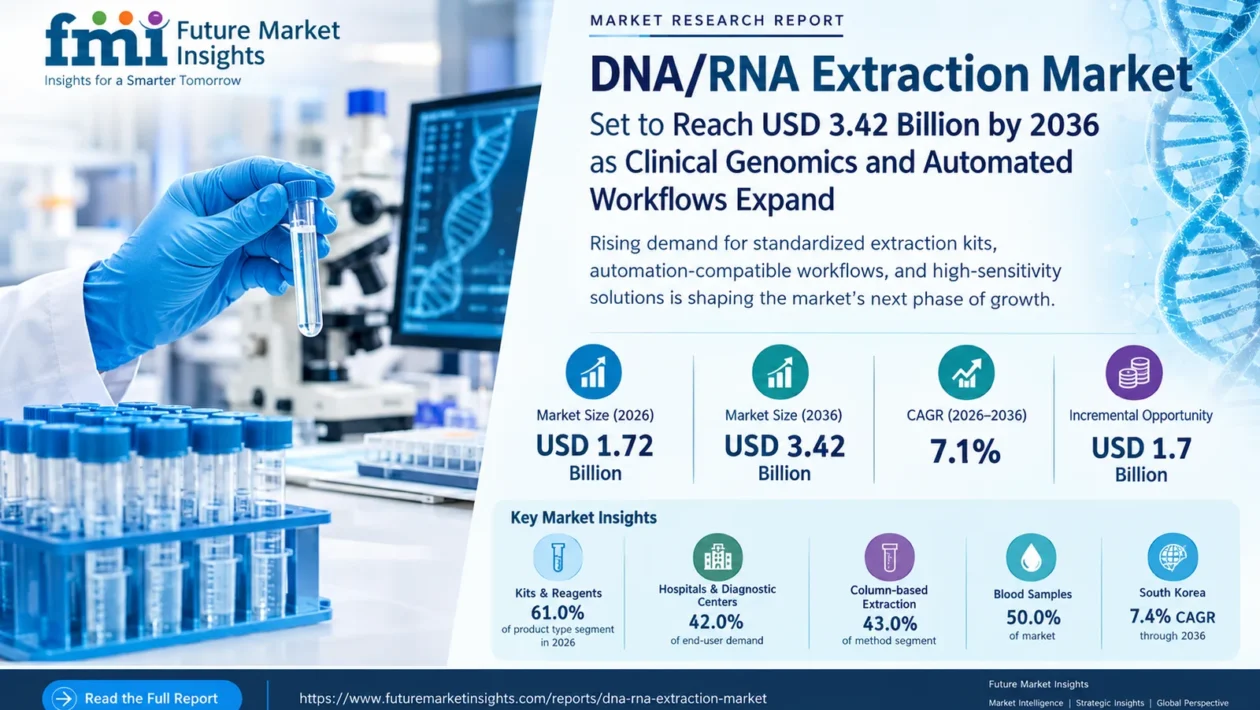
According to Future Market Insights (FMI), the global DNA/RNA extraction market is expected to be valued at USD 1.72 billion in 2026. The market is projected to reach USD 3.42 billion by 2036, representing a 7.1% CAGR between 2026 and 2036. The market was valued at USD 1.61 billion in 2025.
DNA/RNA extraction covers the instruments, kits, reagents, and consumables used to isolate and purify nucleic acids from biological samples. These products support applications across health and diagnostics, oncology, drug discovery and development, and genomic research.
One of the main factors influencing demand is the expansion of clinical genomics. Hospitals and diagnostic laboratories are adding genomic profiling, infectious disease sequencing, and pharmacogenomics to their testing capabilities. As more tests move into routine clinical workflows, laboratories require extraction solutions that can provide consistent results across larger sample volumes.
This is also changing how laboratories approach procurement. Rather than looking only at the extraction step itself, buyers increasingly need to consider compatibility with downstream sequencing, PCR, and other molecular workflows. For larger laboratories, automation compatibility is becoming an important consideration as sample volumes increase.
Kits and reagents are expected to account for 61.0% of the product type segment in 2026, according to FMI. Ready-to-use formats can help laboratories standardize procedures and reduce variability between individual extraction processes. The demand is relevant across both clinical and research environments.
Hospitals and diagnostic centers are expected to account for 42.0% of end-user demand in 2026. This reflects the growing use of molecular diagnostics and clinical genomics, particularly in areas such as oncology, infectious disease testing, and pharmacogenomics.
The choice of extraction method also remains important. Column-based extraction is expected to represent 43.0% of the method segment, supported by established laboratory protocols and the need for reproducible nucleic acid yields. Magnetic bead-based methods are gaining attention in high-throughput environments because they can work with automated liquid-handling systems.
Automation, however, is not equally accessible to every laboratory. High instrument costs and laboratory space requirements can make automated systems difficult to adopt in smaller research facilities and community healthcare settings. Manual extraction formats therefore continue to have a role, particularly where laboratories need lower-cost and flexible workflows.
Another area influencing the market is liquid biopsy. Blood samples currently represent 50.0% of the market, and the growing use of cell-free DNA and RNA is creating demand for extraction workflows capable of working with lower input volumes and high sensitivity.
Liquid biopsy applications can be particularly relevant to cancer screening and monitoring. As these applications develop, extraction becomes an important part of the broader workflow because the quality and quantity of nucleic acids available for downstream analysis can affect subsequent testing.
Precision medicine is adding another layer of demand. Oncology, rare disease research, and pharmacogenomics increasingly depend on genomic information. This creates requirements for extraction workflows that are consistent, validated, and compatible with clinical applications.
The market is also developing differently across countries. South Korea is projected to record a 7.4% CAGR through 2036, supported by investment in precision medicine infrastructure and expanding clinical genomics programs. The USA is projected to grow at 7.3%, with clinical sequencing, large-scale biobanking, and companion diagnostic testing contributing to demand.
The European Union is projected to grow at 7.0%, while the UK and Japan are expected to record CAGRs of 6.9% and 6.7%, respectively. These differences reflect variations in research investment, healthcare infrastructure, clinical sequencing adoption, and regulatory requirements.
The competitive environment includes companies with broad extraction portfolios as well as suppliers focused on specific technologies and sample types. Qiagen N.V. holds an estimated 22.0% market share, according to FMI’s competitive analysis. Thermo Fisher Scientific, Roche Diagnostics, Promega Corporation, Bio-Rad Laboratories, Agilent Technologies, Zymo Research, Macherey-Nagel, Omega Bio-tek, and Norgen Biotek are among the other companies covered in the study.
The market is therefore not being shaped by a single technology or application. Different laboratories have different requirements depending on sample volumes, clinical applications, automation infrastructure, regulatory needs, and downstream testing platforms.
FMI’s research examines these differences through a combination of primary and secondary research. The methodology includes interviews with product manufacturers, end-user procurement teams, and industry specialists, alongside research covering industry associations, regulatory databases, and manufacturer disclosures. Market sizing uses segment- and region-level analysis, with data validation against industry production information and manufacturer disclosures.
For suppliers, laboratory technology companies, diagnostic organizations, and biotechnology businesses, these factors provide a broader view of how the DNA/RNA extraction market is evolving. The important question is not simply how much extraction technology is being purchased, but where demand is coming from, what workflows laboratories are adopting, and which requirements are influencing purchasing decisions.
As genomic testing and molecular diagnostics continue to develop, DNA/RNA extraction will remain an important part of the laboratory workflow. The combination of clinical sequencing, precision medicine, automation, and liquid biopsy is creating new requirements for extraction products while maintaining demand for established methods.
FMI’s DNA/RNA Extraction Market study examines these developments across product type, extraction method, application, end user, sample type, region, and country-level markets. The forecast covers 2026 to 2036.
Read the full research:
https://www.futuremarketinsights.com/reports/dna-rna-extraction-market